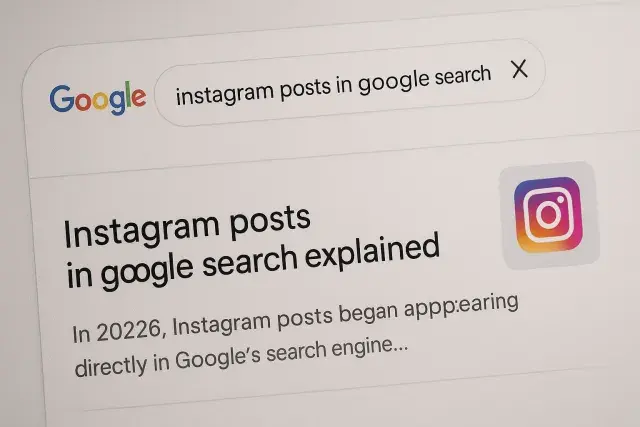

A single Instagram post can now sit between a news article and a company homepage on the same results page, competing for attention as if it were a standard web page. That was not the case a few years ago, when Instagram content stayed almost entirely inside its own app, invisible to anyone browsing the open web. The change is quiet but significant, and it explains why marketers, journalists, and casual users keep noticing familiar square thumbnails showing up where they least expect them.
What makes this shift worth understanding is not the novelty of it, but the mechanics behind it. Instagram posts in google search do not appear randomly; they follow patterns tied to public account settings, caption content, engagement signals, and how Instagram structures its pages for outside indexing. For creators and brands trying to widen their reach, this opens a second channel of discovery that runs parallel to the app itself. Some accounts even combine this with paid promotion tactics - reviewing the instagram reels boost cost before deciding whether boosted video views make sense alongside organic visibility efforts, since higher engagement can indirectly support how a post performs when indexed externally.
This piece breaks the topic into clear parts: how the indexing actually works, what has changed recently, what to expect heading into 2026, and how creators and businesses can use this knowledge practically. By the end, the mechanics behind instagram posts in google search should feel far less mysterious and much more actionable.
What "Instagram Posts in Google Search" Actually Means
At its core, the phrase describes a simple technical reality: certain public Instagram posts can be crawled, indexed, and displayed as individual results outside the Instagram app or website. Instead of only appearing in someone's feed or on a profile grid, a post gets its own indexed page, complete with the caption, thumbnail, and sometimes a snippet of the top comments.
This does not apply to every post. Instagram controls which content is eligible for external indexing through account privacy settings, platform policies, and structured data embedded in each post's page. Private accounts are excluded entirely. Public accounts are eligible, but eligibility does not guarantee visibility - a post still needs to be crawled, indexed, and judged relevant enough to surface for a given query.
How Indexing of Social Media Content Works
Indexing is the process by which a crawler visits a page, reads its content and metadata, and stores that information so it can later be matched against user queries. For Instagram, this means the crawler reads the caption text, alt text on images, hashtags, and any structured markup Instagram provides on the public post page. It does not read private messages, story content, or anything behind a login wall.
The process is largely automated and depends on Instagram allowing external crawlers to access its public pages, which it does selectively. Historically, Instagram restricted this access more tightly than competitors like Twitter or Pinterest, which is part of why indexed posts felt rare for years. That restriction has loosened over time, particularly for business and creator accounts that benefit from broader discovery.
Difference Between Indexed and Non-Indexed Posts
| Indexed Posts | Non-Indexed Posts |
|---|---|
| Belong to public accounts with crawlable pages | Belong to private accounts or restricted profiles |
| Contain readable captions and metadata | May lack captions, alt text, or structured data |
| Can surface for relevant text-based queries | Remain visible only inside the Instagram app |
| Often tied to business or creator account types | Frequently tied to personal, non-public accounts |
Why Instagram Content Started Appearing in Search Results
The shift did not happen because of a single announcement. It reflects a broader pattern where platforms holding valuable content - reviews, visual media, first-hand accounts - gradually open parts of that content to external discovery because it benefits both the platform and outside referral traffic. Instagram, sitting on an enormous volume of visual and textual content, represents exactly that kind of resource.
Businesses and creators pushed for this too. Being invisible outside the app limited organic reach, especially for brands that wanted their posts to double as landing pages for people who had never opened Instagram in the first place. Making certain posts indexable turned each one into a miniature web page, capable of attracting visitors who started their journey outside the platform entirely.
Instagram Posts in Google Search Explained Through Real Use Cases
Consider a small business posting about a new product launch with a detailed caption describing ingredients, pricing, and availability. If that caption contains specific, well-structured text, and the account is public, the post has a reasonable chance of being indexed and surfaced when someone searches for that product by name. A similar pattern applies to event announcements, restaurant menus described in captions, and behind-the-scenes brand storytelling - content that reads well as standalone text, not just as an accompaniment to an image.
Creators benefit in a related but distinct way. A post explaining a tutorial, an opinion, or a niche topic in detail can attract visitors who never intended to browse Instagram but were looking for that specific piece of information. This turns individual posts into discoverable assets rather than content that disappears after a short window of feed visibility.
Instagram Posts in Google Search 2026: What to Expect
Looking toward 2026, the trajectory suggests continued expansion rather than retreat. Platforms that once treated their content as walled gardens have found that controlled external visibility drives referral traffic back to the app, which benefits engagement metrics rather than undermining them. Instagram has no clear incentive to reverse that logic.
Expect indexing eligibility to keep expanding for business and creator accounts, particularly those using Instagram's commerce and creator tools, since these accounts already produce more structured, text-rich content that crawlers can parse effectively. Personal accounts are less likely to see major changes, since privacy expectations for casual users remain a priority for the platform.
Emerging Trends Shaping the Next Update Cycle
- Greater emphasis on caption quality, since well-written text improves indexing relevance
- Expanded eligibility for Reels and video posts with transcribed or captioned text
- Increased use of structured data markup on public Instagram pages
- Growing overlap between social content and traditional web content in mixed result pages
None of these trends are guaranteed outcomes, but they follow logically from the direction the platform has already taken. Anyone tracking instagram posts in google search 2026 developments should watch caption strategy and account type as the two most controllable factors.
Recent Changes and Instagram Posts in Google Search News
Coverage of this topic tends to spike whenever Instagram adjusts its crawling permissions or when noticeable shifts appear in which posts get surfaced externally. These changes are rarely dramatic overnight events; they tend to roll out gradually across account types and regions, which makes them easy to miss unless someone is actively comparing results over time.
What tends to generate the most discussion is when previously invisible content types - such as Reels or Stories highlights - start appearing where they never did before. This kind of shift signals a policy change on Instagram's side rather than a random fluctuation, and it usually affects business accounts first before extending more broadly.
How to Track the Latest Instagram Posts in Google Search Update
- Compare search results for the same query across different weeks to spot new pattern changes
- Check whether previously indexed posts are still appearing or have been removed
- Monitor whether new content types, such as carousel posts or Reels, begin surfacing
- Review account settings periodically, since privacy or business-tool changes can affect eligibility
Following this simple process consistently gives a much clearer picture than relying on scattered anecdotes or one-off observations shared informally.
How This Affects Creators, Brands, and Everyday Users
For creators and brands, external indexing turns each qualifying post into a discoverable page rather than a piece of content locked inside an algorithmic feed. This changes how captions should be written: vague, hashtag-heavy text performs worse than clear, descriptive language that answers a specific question a reader might type.
Everyday users experience this differently. They benefit as searchers, often finding first-hand reviews, event photos, or authentic commentary that traditional web pages do not offer. At the same time, casual posters who never intended their content to reach beyond their followers should understand that public accounts carry this exposure by default.
Common Mistakes That Reduce Visibility
- Writing captions with no descriptive text, relying only on emojis or hashtags
- Keeping business accounts set to restricted visibility unintentionally
- Ignoring alt text options, which crawlers use to understand image content
- Assuming all posts are automatically eligible regardless of account type
Practical Steps to Improve Discoverability
Accounts aiming for better external visibility should treat captions as short-form written content rather than an afterthought to the image. Clear, specific language describing the subject, context, and purpose of a post gives crawlers more to work with. Using Instagram's built-in alt text field, rather than leaving it blank, adds another layer of readable context. Consistency matters too - accounts that regularly produce text-rich, public content tend to build a stronger pattern of indexed posts over time compared to those posting sporadically.
Questions and Answers
Do private Instagram accounts ever appear in outside search results?
No. Private accounts are excluded from external indexing entirely, since their content sits behind a login and follow approval. Only public accounts have posts eligible for this kind of visibility.
Does deleting a post remove it from search results immediately?
Not always immediately. Cached versions of indexed pages can persist for a period after deletion until crawlers revisit and update their records, though this typically resolves within a reasonably short window.
Can Stories or Highlights appear outside the app the way regular posts can?
Stories are temporary by design and generally are not indexed the way permanent feed posts are. Highlights, which save Stories permanently to a profile, have more potential for indexing since they exist as static, accessible content.
Does having more followers increase the chance of a post being indexed?
Follower count alone does not directly control indexing eligibility. Account privacy settings, caption quality, and content structure matter more than audience size, though highly engaged posts sometimes attract more attention from crawlers indirectly.
Is there a way to check if a specific Instagram post is currently indexed?
Searching for exact phrases from the caption, along with the account name, is the most reliable manual way to check. If the post appears with its thumbnail and caption text, it has been indexed successfully.
Should businesses rewrite older captions to improve indexing?
Instagram does not always recrawl edited captions promptly, so updates are not guaranteed to take effect quickly. It is generally more effective to focus on writing strong, descriptive captions for new posts going forward rather than retroactively editing older ones.